
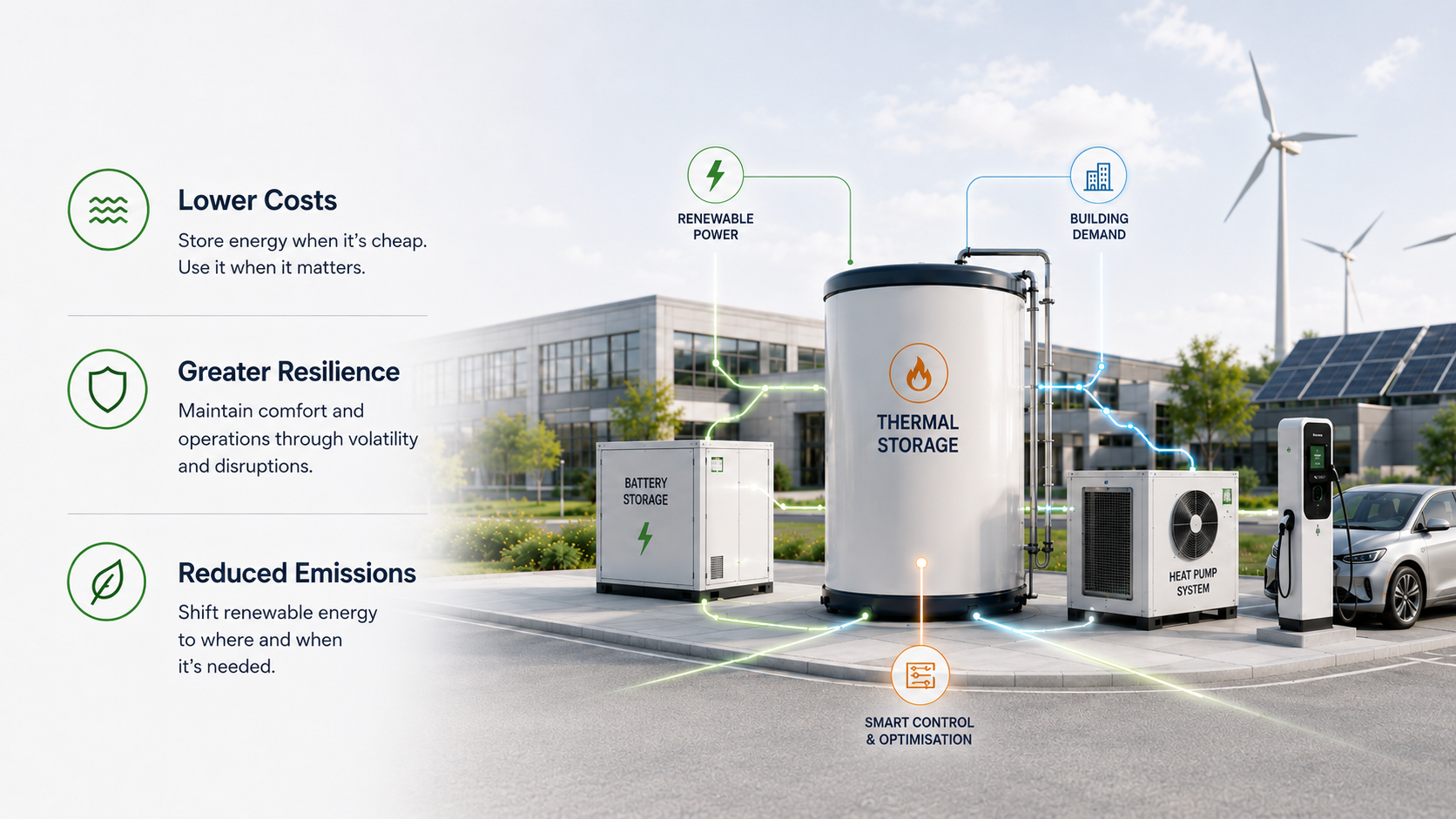
Energy flexibility is becoming one of the most important themes in the energy transition. More renewable electricity, more electrification, more EV charging, more variable electricity prices and more grid constraints all create the same question for customer sites:
The central question
How can a site use energy when it is available, affordable or clean, and reduce demand when energy is expensive, constrained or needed elsewhere?
Most discussions about flexibility focus on electricity and batteries. That is important, but it is not the full picture. Many buildings and industrial sites also have large thermal needs: heating, hot water, process heat, cooling or temperature control. These thermal loads can become a valuable flexibility layer if they are connected to storage and coordinated operation.
Why the thermal side matters
A building or site often consumes energy in different forms. Electricity powers equipment, lighting, EV charging, heat pumps and control systems. Heat is needed for space heating, domestic hot water, industrial processes or other useful thermal services.
If the heat-side demand is managed passively, the site may buy electricity or fuel when it has no choice. But if the site can store useful heat, shift heat production, absorb PV surplus or coordinate heat pumps with batteries and tariffs, the site becomes more flexible.
This is the logic behind thermal-centred flexibility. It does not treat heat as a secondary issue. It treats heat as a central part of the energy system.
Simple definition
Thermal-centred energy flexibility means using thermal storage and heat-side coordination as a core flexibility layer, while coordinating with electrical assets such as BESS, PV, heat pumps, EV charging and the grid.
It is not TES versus batteries
A common mistake is to compare thermal storage and batteries as if one should replace the other. In practice, they solve different parts of the flexibility problem.
Batteries
Strong for fast electrical response, short-duration power support, peak shaving and grid-related services.
Thermal storage
Strong for useful heat, bulk energy shifting, longer-duration thermal capacity and heat-side demand management.
Coordination layer
Creates value by coordinating when assets should store, deliver, shift or reserve capacity across the site.
The stronger strategy is not “battery or thermal storage.” The stronger strategy is the right combination: BESS for fast electrical flexibility, TES for thermal energy capacity, and data-supported coordination to align both.
What assets can be part of the system?
Thermal-centred flexibility is not one device. It is a site-level system approach. Depending on the site, it can include:
- Modular thermal energy storage
- Battery energy storage systems
- Solar PV
- Heat pumps
- Electric heaters or power-to-heat units
- EV charging infrastructure
- Grid electricity and tariff signals
- Building energy management systems
- Local sensors, data logging and control
- Forecasting and optimisation software
The value does not come from simply installing many assets. The value comes from making the assets work together around the real constraints and opportunities of the site.
Where can thermal-centred flexibility create value?
The best early applications are sites where several energy drivers overlap. For example, a building may have PV production during the day, heating demand in the morning and evening, EV charging plans, peak-power charges and limited grid capacity.
In such a case, thermal storage can absorb energy when it is available, the battery can manage short electrical peaks, the heat pump can operate at better times, and the coordination layer can support practical operation based on demand, tariffs and operating constraints.
Typical value drivers
- Reducing peak-power exposure
- Increasing local use of PV electricity
- Shifting heating demand away from expensive periods
- Supporting EV charging without unnecessary grid stress
- Improving resilience through multiple energy paths
- Creating measurable pilot data for future scale-up
Why this matters for property owners and industrial sites
Many property owners and site operators are already facing a more complex energy reality. Electricity prices can vary. Grid capacity can become a constraint. PV export may not create enough value. EV charging can increase power demand. Heating electrification can create new peak loads.
A thermal-centred flexibility approach helps the site move from passive energy consumption to active energy management. The site becomes more capable of using electricity at better times, storing energy as heat, delivering stored heat when useful and reducing stress on the grid.
What makes the EnerVectum approach different?
EnerVectum is built around the idea that customer sites need integrated flexibility, not isolated assets. The platform combines modular thermal storage with mature energy assets and coordinated operation to create practical, measurable and scalable site-level value.
The distinctive role is not based on one isolated storage component. It is based on a thermal-centred system approach: using heat-side flexibility as a practical layer between physical infrastructure, site operation, electricity use and future flexibility opportunities.
EnerVectum’s position
Batteries are solving fast electrical flexibility. EnerVectum addresses the missing thermal-flexibility layer, where buildings and industrial sites can shift large amounts of useful energy, reduce peak exposure and prepare for a more flexible energy system.
Why pilots are important
Thermal-centred flexibility should be proven with real site data. A good pilot is not only a technical demonstration. It should show how much energy can be shifted, how the thermal and electrical assets interact, how coordination logic improves operation, and how the same model can be repeated at future sites.
For EnerVectum, a strong pilot should create four types of proof:
- Technical proof: the system works under real operating conditions.
- Customer proof: the site sees measurable value.
- Coordination proof: integrated operation improves site performance.
- Replication proof: the concept can be repeated at similar sites.
Conclusion
Thermal-centred energy flexibility is a practical response to a changing energy system. It recognises that heat, electricity, storage, PV, EV charging and control should not be managed as separate islands.
When coordinated correctly, these assets can help customer sites reduce costs, improve resilience, use more renewable energy and prepare for future flexibility markets.
This is the category EnerVectum is working to build: integrated, thermal-centred flexibility for buildings, light industry and local energy systems.
Want to explore thermal-centred flexibility for your site?
EnerVectum welcomes dialogue with property owners, customer sites, technology partners, investors and innovation actors interested in practical flexibility and measured pilot development.