
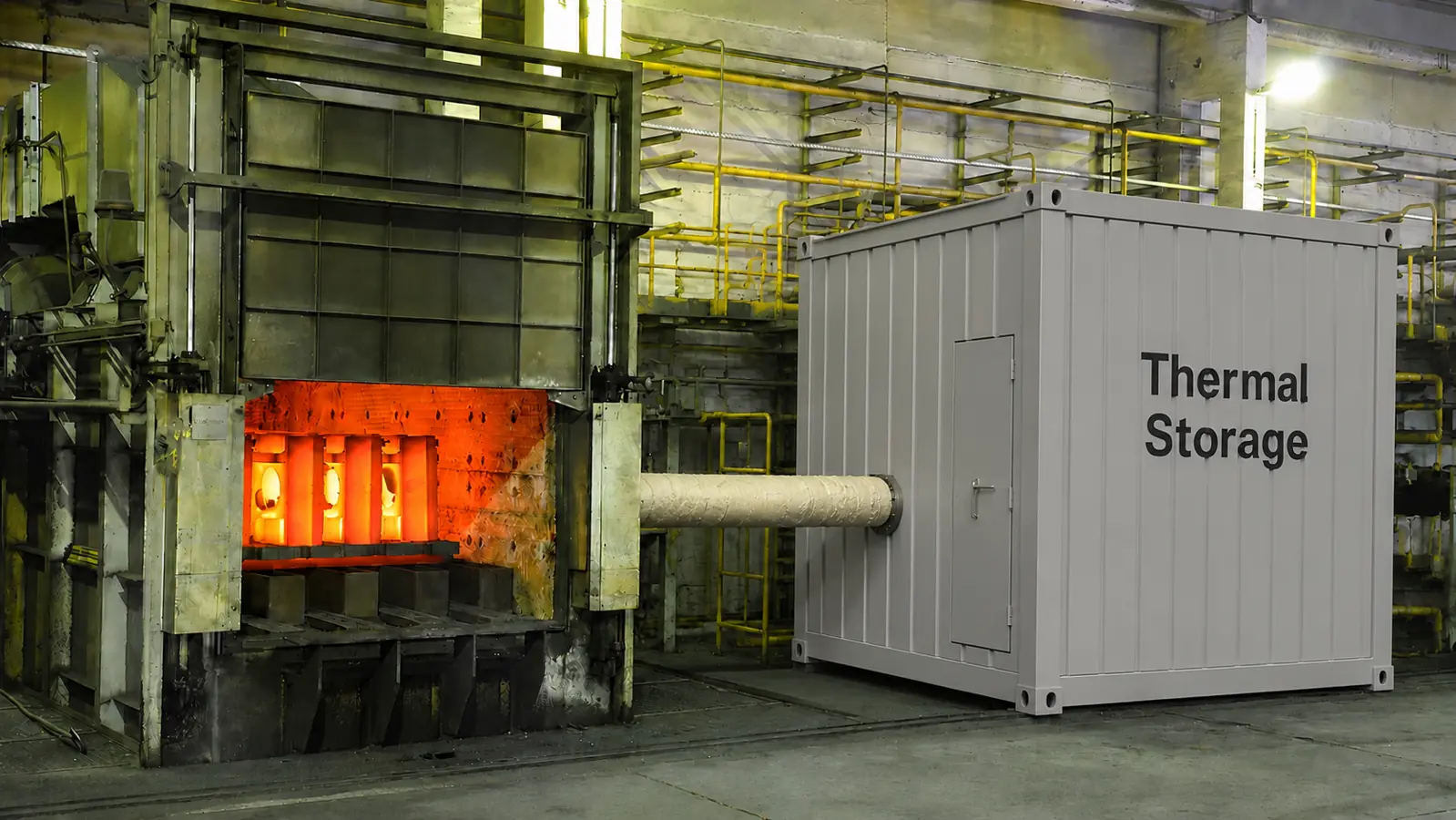
Heat-intensive industries are entering a new phase of the energy transition. For many years, industrial heat has depended on continuous fossil fuel combustion, especially natural gas. That model is now under pressure from energy-price volatility, CO₂ costs, electrification, renewable integration and growing demand for lower-carbon products.
The challenge is not only how to replace fossil fuels. The deeper challenge is how to make industrial heat more flexible, controllable and resilient without disturbing production.
This is relevant for glass manufacturing, ceramics, bricks and tiles, food and beverage, pulp and paper, chemicals, pharmaceuticals, metals and industrial parks. These sectors may look different, but they share one important issue: heat is central to production, and energy decisions cannot be separated from process reliability.
The practical question
How can heat-intensive sites use more renewable electricity, recovered heat and thermal storage while keeping production stable, competitive and reliable?
Why heat-intensive industries need thermal flexibility
Many industrial sites do not consume energy like ordinary buildings. They require heat at specific temperatures, often continuously, and often with strict product-quality requirements. A furnace, kiln, dryer, reactor, pasteurisation line or steam system cannot simply be switched on and off without consequences.
At the same time, the energy system around these industries is changing. Renewable electricity is growing, but it is variable. Electricity prices can shift strongly between hours. Grid connection capacity can become a bottleneck. Fossil fuels may become more expensive or less attractive because of regulation, CO₂ costs and customer pressure.
Industrial sites may also release large amounts of waste heat. This heat can be valuable, but only if it can be captured, stored, upgraded or matched with the right demand at the right time.
From thermal storage to thermal flexibility
Thermal energy storage is often described as a heat battery. That is useful, but incomplete. In industrial applications, the value is not only the storage unit itself. The value comes from how storage interacts with the full site.
A thermal flexibility system may include:
- thermal energy storage for low-cost heat capacity,
- electric heating or power-to-heat units,
- industrial heat pumps where the temperature level allows,
- waste heat recovery from furnaces, kilns, dryers or process streams,
- heat exchangers and thermal interfaces,
- battery energy storage for fast electrical flexibility,
- PV or renewable electricity supply,
- smart control, measurement and verification,
- integration with existing boilers, process lines and building systems.
In this structure, batteries and thermal storage are not competitors. Batteries are strong for fast electrical response, power peaks and short-duration balancing. Thermal storage is strong for bulk heat capacity, heat shifting, waste heat reuse and lower-cost energy buffering.
The most valuable solution is often the combination
Industrial decarbonisation is not only about replacing one fuel with one new technology. It is about coordinating heat, electricity, storage, recovered energy and site operation as one integrated flexibility system.
Glass manufacturing as a strong example
Glass manufacturing is a useful example because it shows both the opportunity and the difficulty of industrial heat decarbonisation.
Glass production is energy-intensive, temperature-sensitive and reliability-critical. The melting furnace is normally one of the most important and sensitive assets in the plant. A glass producer cannot risk process instability, product-quality problems or furnace damage for a theoretical energy saving.
At the same time, the sector is moving toward new furnace concepts and higher electrification. European initiatives such as the VOLTA project, involving AGC and Saint-Gobain, show that hybrid furnace concepts are already being developed for flat glass production. FEVE has also described hybrid furnace technology as a pathway that can use a high share of renewable electricity in container glass production.
For EnerVectum, the correct message is not that thermal storage can simply replace the glass furnace. That would be too narrow and too risky. The stronger message is that thermal flexibility can support the energy system around glass production.
Possible use cases in glass and similar industries
Waste heat recovery
Heat from flue gases, cooling zones or hot product streams can be captured and reused for preheating, drying, hot water, space heating or nearby heat users.
Power-to-heat support
Electricity can be converted into heat when prices are favourable, then stored and used later to reduce exposure to peak prices and grid constraints.
Hybrid furnace support
As furnaces become more electrified, thermal storage and coordinated operation can support auxiliary loads and reduce simultaneous peak demand.
Preheating and drying
Batch preheating, cullet preheating, drying and other non-core thermal loads may be safer starting points than direct furnace intervention.
Heat and cold integration
Some industries need both heating and cooling. A flexible site strategy can coordinate thermal storage, refrigeration, heat pumps and process loads.
Measured pilot pathways
A first project should measure recovered energy, shifted energy, reduced peak power, gas reduction, CO₂ impact and operational stability.
Where similar logic applies
Glass is only one example. The same thermal flexibility logic can support many other industrial sectors.
Ceramics, bricks and tiles
Kilns, dryers and firing processes create strong heat demand and often reject useful heat. Storage can support drying, preheating and partial electrification.
Thermal flexibility layer
EnerVectum focuses on the missing heat-side flexibility layer: storage, recovered heat, electrification, batteries and control working together.
Food and beverage
Breweries, dairies, bakeries and food processors often need hot water, steam and cooling at the same site, creating opportunities for combined heat and cold flexibility.
Pulp and paper
Drying and steam systems create large thermal loads where storage and waste heat recovery can reduce peaks and support fuel switching.
Chemicals and pharma
Reliable steam, hot water, cooling and precise temperature control can benefit from thermal buffering and carefully staged electrification.
Industrial parks
Heat from one process can become a resource for another when storage, timing, temperature levels and business models are coordinated.
Why the first step should be an assessment
For high-temperature and production-critical industries, the first step should not be to sell equipment. The first step should be a structured thermal flexibility assessment.
Such an assessment should answer:
- Where is heat consumed?
- At what temperature levels?
- Which loads are continuous and which are flexible?
- Where is waste heat available?
- What is the hourly electricity and fuel cost profile?
- Is PV or renewable electricity available?
- Are there power-tariff or grid-capacity constraints?
- Which thermal loads can be shifted without disturbing production?
- Where would a pilot create measurable value with acceptable risk?
Based on this, EnerVectum can help define a staged pathway from mapping to concept design, pilot validation and later replication.
From equipment project to strategic flexibility asset
Historically, industrial energy projects have often been evaluated as isolated efficiency measures. The question was usually: how much energy can be saved, and what is the payback time?
That question is still important, but it is no longer enough. Industrial sites increasingly need energy systems that can respond to electricity prices, grid constraints, renewable availability, CO₂ targets and operational resilience.
Thermal storage, waste heat recovery and power-to-heat become more valuable when they are designed as part of a broader flexibility strategy rather than as isolated pieces of equipment.
EnerVectum’s perspective
EnerVectum helps industrial and commercial sites explore how thermal storage, recovered heat, electrification, batteries, PV, heat pumps and intelligent control can work together as one practical flexibility system.
For the glass industry, this may start with waste heat recovery, auxiliary heat loads, preheating, storage, power-to-heat or hybrid furnace support. For similar industries, the same logic can be adapted to kilns, dryers, steam systems, hot water, cooling loads and industrial energy hubs.
The goal is not to force a single solution onto every site. The goal is to identify where flexibility can reduce cost, emissions and energy risk without compromising production.
Conclusion
Heat-intensive industries need more than cleaner energy. They need more controllable energy.
Glass manufacturing shows the challenge clearly: high-temperature processes, continuous operation, high energy cost, decarbonisation pressure and limited tolerance for disruption. Similar patterns exist in ceramics, food and beverage, pulp and paper, chemicals, pharmaceuticals, metals and industrial parks.
The strongest starting point is not a promise to replace the core process. It is a practical question:
Where can thermal flexibility reduce cost, emissions and energy risk without compromising production?
That question can open a serious pathway from energy mapping to measured pilots and repeatable industrial decarbonisation.
Could thermal flexibility support your industrial site?
EnerVectum welcomes dialogue with glass producers, heat-intensive industries, property owners, energy partners and innovation actors interested in practical thermal storage, waste heat recovery and measured flexibility pilots.
References
- European Climate, Infrastructure and Environment Executive Agency (CINEA), VOLTA project: powering the hybrid furnace transition in Europe’s flat glass industry. CINEA project article
- AGC Glass Europe, Hybrid mid-sized pilot furnace for flat glass. AGC project page
- FEVE, Forging a Net Zero Future for Glass Packaging. FEVE decarbonisation page
- International Energy Agency (IEA), Renewables for Industry, Executive Summary. IEA report page
- Kraftblock, Energy Solutions for Glass & Ceramics. Kraftblock industry page
- ENERGYNEST, Glass Industry and Thermal Energy Storage. ENERGYNEST article
- Renewable Thermal Collaborative, Thermal Energy Storage. RTC resource page
- Scipioni, R., Gil Bardají, M. E., Barelli, L., Baumann, M., & Passerini, S. (eds.), Hybrid Energy Storage: Case Studies for the Energy Transition, Springer, Lecture Notes in Energy, 2026. Springer open-access book