
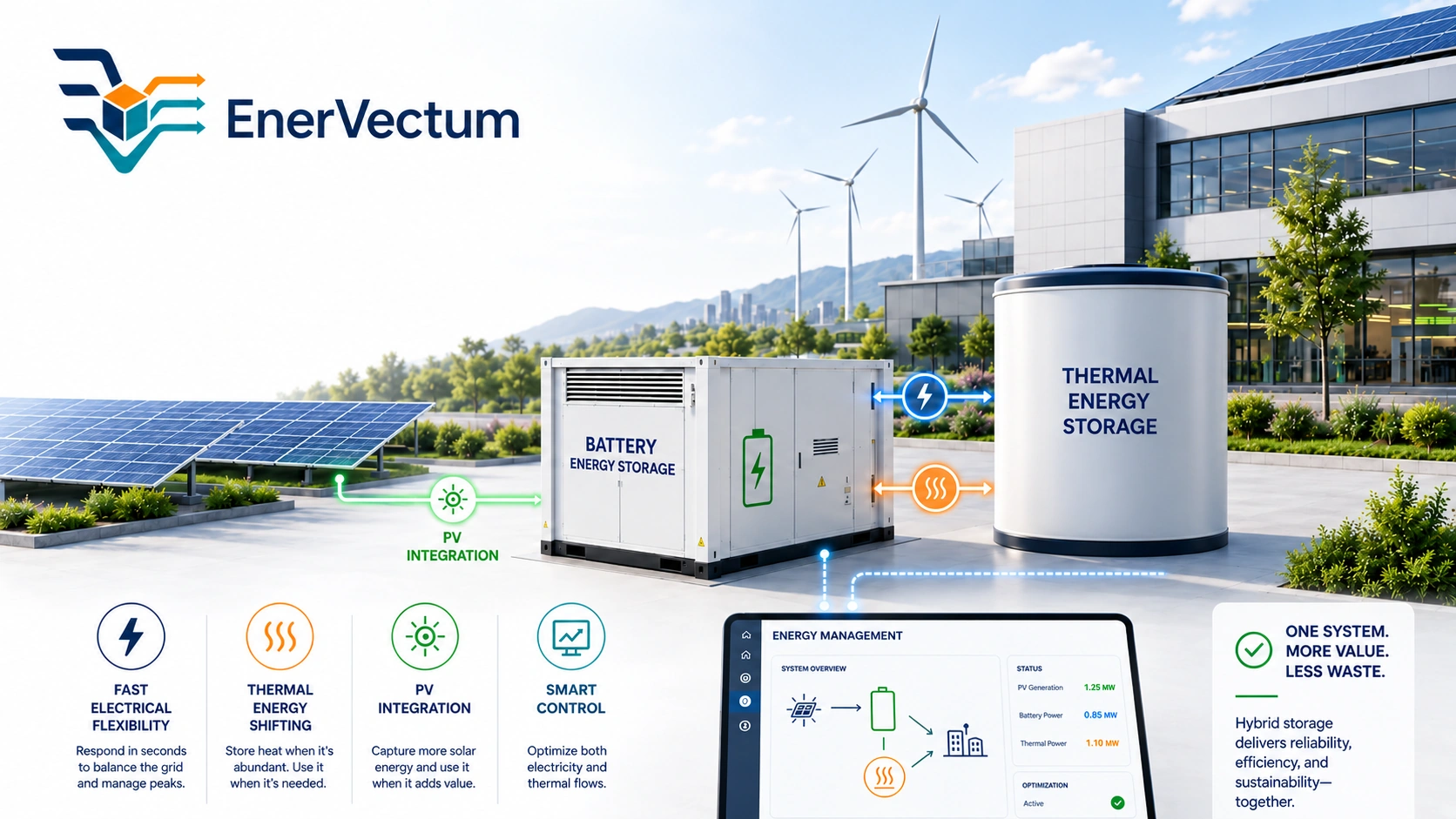
Batteries and thermal energy storage solve different flexibility problems. In some sites, one technology may be enough. In others, using both can create greater technical and economic value than relying on either asset alone.
The useful question is therefore not which storage technology is best. It is which flexibility problem the site needs to solve, and whether electrical storage, thermal storage or a coordinated combination provides the strongest business case.
The better question
Which asset should solve which part of the site’s energy problem, and when does combining them create additional value?
Batteries are strong for electrical flexibility
Battery energy storage systems are well suited to fast electrical response. They can charge and discharge quickly, support short-duration peak management, respond to changing electricity conditions and help coordinate loads such as EV charging.
For sites with rooftop PV, variable tariffs, power-capacity constraints or short electrical peaks, BESS can therefore be an important flexibility asset.
But a battery stores electricity. If a major part of the site’s final demand is heating or cooling, storing all flexibility electrically may not always be the most economical or technically appropriate approach.
Thermal storage is strong where the useful demand is heat or cooling
Thermal energy storage stores useful energy in thermal form. This can be particularly relevant for buildings and industrial sites where space heating, hot water, cooling or process heat represents a significant share of demand.
Thermal storage can allow heat or cooling to be produced at a more favourable time and used later. Depending on the site, this can reduce electrical demand during expensive or constrained periods and improve the utilisation of heat pumps, recovered heat or locally produced electricity.
Its role is therefore different from a battery: it provides flexibility on the thermal side of the site.
BESS
Fast electrical response, short-duration storage, peak management and coordination of flexible electrical demand.
TES
Thermal energy shifting, heat or cooling storage and flexibility on the thermal side of the site.
Coordination
Metering and control determine when each asset should operate according to tariffs, demand, local generation and site constraints.
When does combining BESS and TES make sense?
A hybrid approach is most relevant when the site has both meaningful electrical and thermal flexibility needs. For example, a commercial building may have PV generation, EV charging, heating demand and an electrical connection that becomes constrained during certain periods.
In that situation, the battery and thermal storage can serve different functions rather than competing for the same task.
- BESS can respond to short electrical peaks.
- TES can shift heating or cooling demand over longer periods.
- PV can charge either electrical or thermal storage where appropriate.
- Heat pumps can operate when electricity conditions are more favourable.
- EV charging can be coordinated with other flexible loads and storage.
The value of the combination depends on the site’s demand profile, tariffs, storage duration, equipment cost and operating constraints. Using both is not automatically better.
A simple example: a PV-rich commercial building
Consider a property with rooftop PV, significant heating demand, planned EV charging and limited electrical connection capacity.
During sunny periods, PV production may exceed immediate site demand. Later in the day, EV charging and heating may increase electricity use at the same time that grid tariffs or local peaks become less favourable.
A coordinated configuration could use the assets differently:
- Use PV directly whenever local demand exists.
- Charge the battery when electrical storage creates value.
- Convert suitable surplus electricity into useful thermal energy.
- Use stored heat later instead of running thermal equipment at a peak period.
- Coordinate EV charging with storage and site demand.
The objective is not maximum use of every technology. It is lower avoidable cost and better use of the site’s existing and planned energy infrastructure.
How the two storage types fit into one site
Electrical flexibility
Grid electricity, PV, BESS, EV charging, electrical loads and power tariffs.
EnerVectum coordination
Site data, metering, forecasting, control logic, operating constraints and measured performance.
Thermal flexibility
Heat pumps, thermal storage, heating, cooling, recovered heat and flexible thermal demand.
EnerVectum’s role is to coordinate the relevant assets at site level. BESS and TES can be used independently or together, depending on what the customer is trying to achieve.
What creates customer value?
A hybrid storage system should be justified by measurable site outcomes, not by the number of technologies installed.
Potential value areas
- Lower avoidable energy cost: move selected energy use toward more favourable operating periods.
- Peak and grid-cost management: use electrical and thermal flexibility to reduce avoidable demand peaks.
- Higher PV self-use: create more options for using locally produced electricity instead of exporting it.
- Better asset utilisation: coordinate batteries, heat pumps, storage and flexible loads around whole-site value.
- Support for electrification: manage new loads such as EV charging or heat pumps within site constraints.
- Future flexibility readiness: establish the metering and control foundation needed for more advanced site operation.
These are potential value pathways rather than guaranteed savings. The business case depends on tariffs, demand patterns, asset cost, operating conditions and the site’s existing infrastructure.
When one storage technology may be enough
Hybrid storage is not the right answer for every property.
A site dominated by fast electrical peaks may justify BESS without TES. A site with large flexible heating demand but limited electrical flexibility may justify TES without a battery. In other cases, neither storage technology may be economically attractive.
This is why technology selection should follow the site assessment rather than precede it.
What should be measured in a pilot?
Where BESS and TES are used together, the pilot should determine whether their interaction creates additional value compared with operating each asset independently.
- Change in avoidable energy and peak-related cost.
- Change in PV self-use and electricity export.
- Amount of electrical and thermal energy shifted.
- Interaction between BESS, TES, heat pumps and flexible loads.
- Controller behaviour under real tariffs, demand and site constraints.
- Investment and replication logic for similar sites.
The important result is not simply that both technologies can operate. It is evidence that their coordinated use improves the technical or economic performance of the site.
EnerVectum’s role
EnerVectum is not built around the assumption that every project needs both batteries and thermal storage. Its role is to assess the site, identify the useful flexibility, select the relevant assets and coordinate them through metering, interfaces, control and staged validation.
EnerVectum’s position
Batteries and thermal storage are complementary when they solve different parts of the same site problem. They should be combined only when the resulting technical and economic value justifies the additional system complexity.
Conclusion
Batteries and thermal storage are not competing versions of the same technology. Batteries provide electrical flexibility. Thermal storage provides thermal flexibility. Their value depends on the problem the site needs to solve.
In some properties, one storage technology will be enough. In others, coordinated BESS and TES can reduce avoidable cost, improve local energy use and manage electrical and thermal demand more effectively.
The strongest approach is therefore site-first: understand the economics and constraints, choose the right assets, and measure whether coordination creates additional value.
Could hybrid storage create value at your site?
EnerVectum welcomes dialogue with property owners, industrial sites and partners interested in evaluating whether BESS, thermal storage or a coordinated combination is justified by the site.