
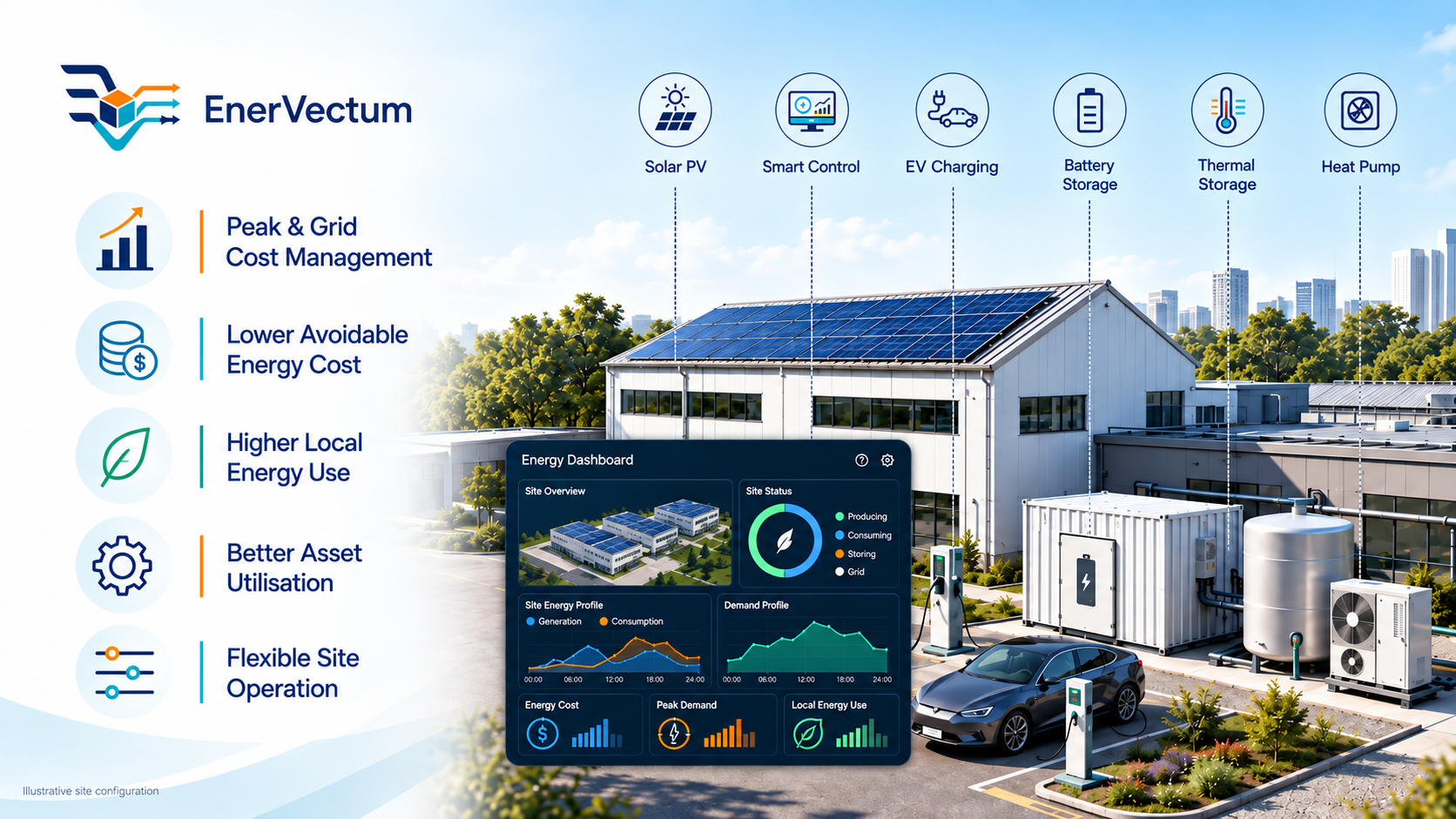
Energy flexibility is the ability of a building or site to change when and how energy is produced, stored, converted or consumed. For property owners and site operators, the practical objective is usually economic: reduce avoidable energy cost, manage peaks, use local energy more effectively and make better use of existing infrastructure.
Buildings are becoming more complex energy systems. A single property may now include rooftop PV, heat pumps, batteries, EV charging, thermal storage, smart meters and building-control systems, while also facing changing tariffs, grid constraints and growing electrification.
The challenge is therefore not simply to add more equipment. It is to decide which assets are actually useful for the site and coordinate them around the site’s technical needs and business case.
The practical question
Where can a site shift energy, reduce avoidable cost or make better use of local generation without compromising comfort, reliability or operations?
Why energy flexibility matters to property owners
Electricity prices, peak-power tariffs, grid capacity, PV production and electrified heating or transport can all change the economics of a property. In some cases, the largest cost driver is total energy use. In others, it may be short demand peaks, exported solar electricity, constrained grid capacity or the timing of heating and EV charging.
Energy flexibility creates another option: instead of treating demand as fixed, part of the site’s energy use can be moved in time or supplied through coordinated storage and conversion.
The value depends on the individual property. A flexibility project should therefore begin with site data and cost drivers, not with a predetermined technology package.
Energy flexibility is more than battery storage
Batteries are useful for fast electrical response, short-duration storage and management of electrical peaks. But many buildings also have large thermal loads through space heating, hot water or cooling.
Thermal flexibility can therefore be important as well. Heat can sometimes be produced, stored or shifted to a more favourable time, reducing electrical demand when power is expensive or constrained.
The right solution may use BESS, thermal energy storage, a heat pump, PV, EV charging control, flexible loads or a combination of these. No single technology is required in every EnerVectum configuration.
Electrical flexibility
BESS, PV, EV charging and flexible electrical loads can respond to demand peaks, local generation, tariffs and grid conditions.
Thermal flexibility
Thermal storage, heat pumps and flexible heating or cooling demand can shift useful thermal energy across time.
Coordination
Metering and control connect the relevant assets so operating decisions can be made around whole-site value rather than individual equipment.
Typical problems where flexibility can create value
Strong cases often appear where several cost or capacity drivers overlap. Examples include:
- High electricity cost or exposure to variable tariffs.
- Peak-power charges or recurring short demand peaks.
- Rooftop PV exporting more electricity than the site can use locally.
- Limited or expensive grid-connection capacity.
- EV charging creating new electrical demand peaks.
- Heating or cooling loads that can be shifted without affecting operations.
- Useful recovered heat that is not fully utilised.
- Existing energy assets operating independently rather than as one system.
These problems do not automatically justify new storage or control equipment. The first task is to quantify the size, timing and economic importance of the flexibility opportunity.
How a flexible site is structured
A flexible site links site conditions, flexible assets and useful energy demand through a common coordination layer.
Site conditions
Grid electricity, PV, recovered heat, demand profiles, tariffs, weather, operating schedules and grid limits.
Flexible assets & coordination
BESS, thermal storage, heat pumps, EV charging, flexible loads, metering, forecasting, control and monitoring.
Customer outcomes
Lower avoidable energy cost, peak management, higher local-energy utilisation, better asset use and greater operating flexibility.
The exact architecture varies from site to site. A commercial building with PV export and EV charging may require a different solution from a property dominated by heating demand or constrained electrical capacity.
What property owners can gain
The most useful way to evaluate energy flexibility is through measurable property outcomes rather than technology features.
Potential value areas
- Lower avoidable energy cost: shift selected consumption, storage or conversion toward more favourable operating periods where tariffs and demand patterns support it.
- Peak and grid-cost management: reduce avoidable peaks and make better use of available connection capacity.
- Higher PV self-use: increase the value of local solar generation by coordinating when energy is stored or consumed.
- Better asset utilisation: coordinate existing and planned equipment around whole-site priorities.
- Support for electrification: prepare the property for heat pumps, EV charging or other new electrical loads.
- Better investment decisions: use measured operating data to decide which upgrades should be expanded, modified or avoided.
These are potential value pathways, not guaranteed savings. The actual result depends on the site’s demand profile, tariffs, equipment, operating constraints and investment cost.
Why site operators are essential
A flexibility strategy must work within real building operation. Comfort, uptime, safety, maintenance access, operating schedules and user behaviour remain more important than an optimisation model on paper.
Facility managers and technical operators often hold the information that determines whether a concept is practical: available installation space, meter structure, heating-system interfaces, BMS access, seasonal demand, operating hours and equipment limitations.
For this reason, EnerVectum starts with the site and its operating reality. The platform should fit the property rather than forcing the property to fit a fixed technology package.
What data is useful for a first assessment?
A useful screening does not need perfect data, but enough information is required to understand the main cost drivers and operating constraints.
- Hourly or sub-hourly electricity import and export data.
- Electricity tariff and peak-power cost structure.
- PV production and export data, if available.
- Heating and hot-water demand information.
- Existing heat pumps, boilers, BESS or thermal-storage systems.
- EV charging capacity and planned future loads.
- Available electrical connection capacity.
- Existing metering, BMS and control-system information.
- Available installation space and operating constraints.
With this baseline, it becomes possible to identify whether flexibility is worth investigating further and which technical options deserve attention.
Which properties are a strong fit?
EnerVectum is most relevant where several energy vectors or flexible assets need to be coordinated at site level. Strong candidates may include commercial buildings, property portfolios and light-industrial sites with a combination of tariff exposure, heating or cooling demand, PV production, peak demand, EV charging, grid constraints or recoverable heat.
Strong site profile
A strong candidate has measurable energy data, a visible cost or capacity problem, assets or loads that can provide flexibility, and a clear interest in validating the business case before wider deployment.
What EnerVectum adds
EnerVectum’s role is not to manufacture every component used at the site. It is to define and coordinate the integrated site solution: assess the problem, select relevant technologies, structure interfaces and metering, coordinate commissioning, and progressively develop the control and optimisation layer.
This creates a practical pathway from site problem to measured solution:
- Understand the site’s energy use, costs and constraints.
- Identify the flexibility opportunities worth pursuing.
- Select the relevant assets and define their interfaces.
- Establish metering, control and validation requirements.
- Measure technical and economic performance.
- Use the evidence to decide whether and how the solution should be replicated.
Conclusion
Energy flexibility is ultimately about using energy infrastructure more economically and intelligently. For property owners, the strongest projects are those where technical flexibility solves a measurable cost, capacity or operating problem.
Batteries, thermal storage, PV, heat pumps, EV charging and flexible loads can all contribute, but the useful combination depends on the site. The value comes from selecting the right assets and coordinating them around the property’s real priorities.
EnerVectum develops this site-level integration and coordination pathway, with current work focused on measured pilot validation and progressively more capable multi-asset control.
Could your property benefit from energy flexibility?
EnerVectum welcomes dialogue with property owners, site operators and light-industrial sites where energy cost, peak demand, local generation or grid constraints create a measurable flexibility opportunity.