
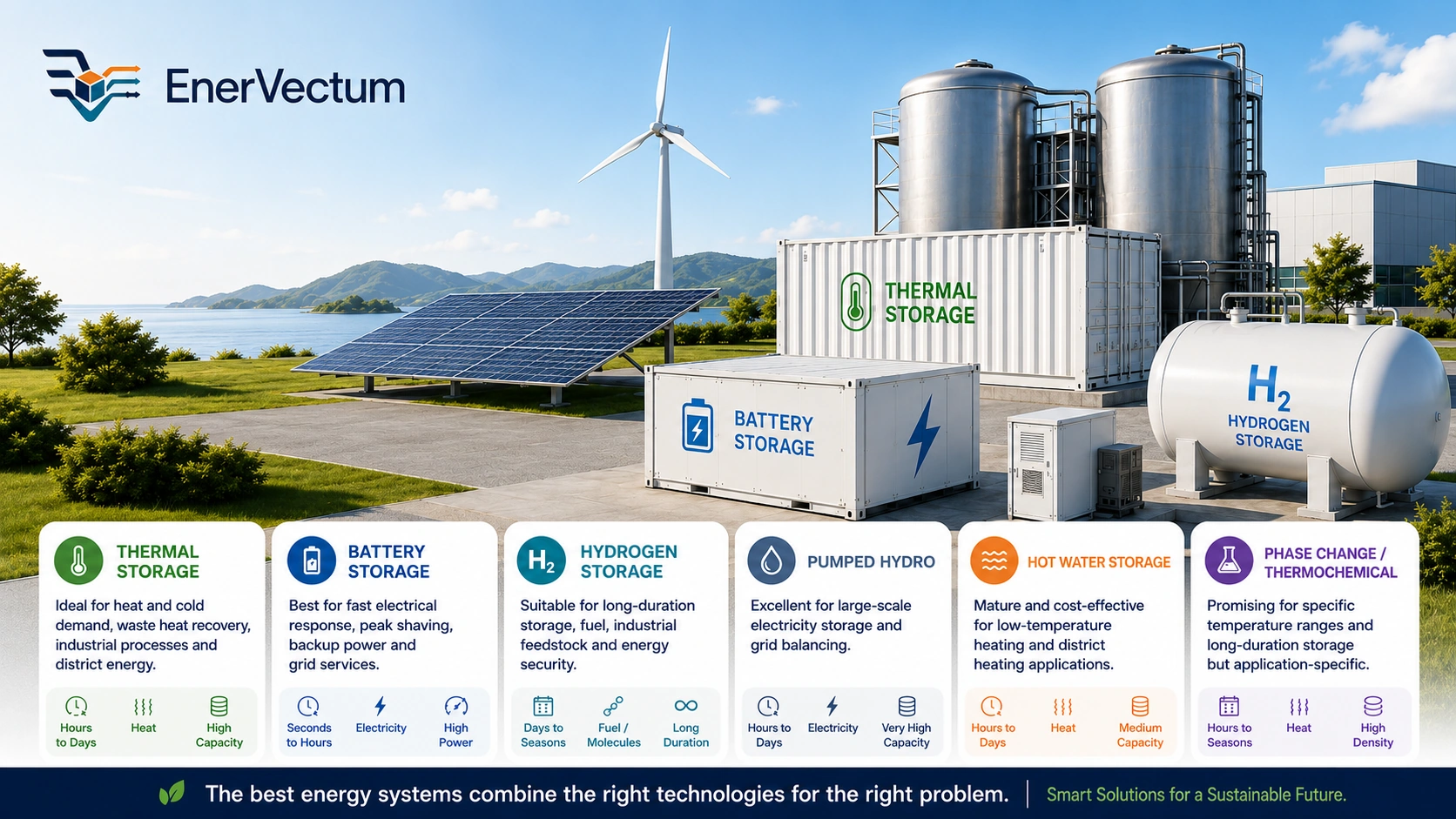
Energy storage is not one market and there is no universal “best” technology. The right choice depends on what the site is trying to achieve: reduce electricity peaks, increase PV self-use, shift heating demand, recover waste heat, provide backup power, manage grid constraints or support longer-duration energy needs.
For customers, the most important question is therefore not which technology has the most attention in the market. It is which option solves the site’s technical problem with a credible business case.
The practical question
Which storage technology fits the site’s final energy need, duration, power requirement, constraints and economics?
Start with the site problem, not the technology
Storage selection should begin with the customer’s energy profile and cost drivers. A solution that is excellent for fast electrical response may be unsuitable for storing industrial heat. A technology designed for seasonal storage may be far too complex for a commercial building with a four-hour peak problem.
A first assessment should ask:
- Is the final demand electricity, heat, cooling, fuel or a combination?
- Is the required storage duration seconds, hours, days or longer?
- Is the main problem energy cost, peak power, grid capacity, resilience or local energy use?
- How often will the storage charge and discharge?
- What space, temperature, safety, permitting and integration constraints apply?
- What investment level can the expected value justify?
These questions help prevent a technology-first decision and make the comparison more relevant to the site.
A practical comparison of storage options
| Technology | Strong fit | Less suitable when |
|---|---|---|
| Lithium-ion batteries | Fast electrical response, peak management, PV self-use, backup applications and short-duration electrical storage. | The main requirement is large thermal-energy capacity or long-duration heat storage. |
| Thermal energy storage | Heating, cooling, process heat, waste-heat recovery, power-to-heat and thermal load shifting. | Direct electrical discharge or very fast electrical response is required. |
| Hot-water storage | Mature low-temperature heat storage for buildings, hot water and district heating. | Higher-temperature or more compact thermal storage is required. |
| Hydrogen | Long-duration molecular storage, industrial feedstock, fuels and selected energy-security applications. | The objective is efficient short-cycle local electricity or heat shifting. |
| Pumped hydro | Large-scale electricity storage, grid balancing and long asset life. | Suitable geography, permitting or grid-scale project conditions are unavailable. |
| Phase-change materials | Applications where compact storage or a defined operating temperature is valuable. | Material cost, stability or integration complexity outweighs the benefit. |
| Thermochemical storage | Future specialised applications requiring high energy density or long storage duration. | Commercial maturity, simplicity and near-term deployment are priorities. |
| Flywheels & supercapacitors | Very fast power response, power quality and short-duration grid services. | Large energy capacity over hours or thermal storage is required. |
Lithium-ion batteries: strong for fast electrical flexibility
Lithium-ion batteries are highly effective when the problem is electrical. They can respond quickly, reduce short demand peaks, store PV electricity, support EV charging and provide selected grid-related services.
Their strongest role is usually where fast response and electrical power matter. For a building with rooftop PV and peak-power exposure, BESS may therefore be an important part of the site strategy.
But if the final demand is primarily heat, storing all flexibility electrically is not automatically the most direct or economic option.
Thermal energy storage: strong where the final demand is heat or cooling
Thermal energy storage stores energy in thermal form. Depending on the application, this may involve water, solid media, phase-change materials or other storage concepts across different temperature ranges.
TES is particularly relevant when the site needs to shift heating or cooling, use recovered heat later, move heat-pump operation away from unfavourable periods or convert suitable electricity into useful heat for later use.
Its role is therefore different from a battery. It provides flexibility on the thermal side of the site and should be evaluated against the actual thermal duty, temperature level, duration and economics of the application.
Hot-water storage: mature and practical at lower temperatures
Hot-water tanks and accumulators are among the most established thermal-storage technologies. They are widely used in buildings, domestic hot-water systems and district heating where the required temperature range is moderate.
Their limitation is mainly application fit. Where higher temperatures, more compact storage or industrial process heat are required, other TES approaches may become more suitable.
Hydrogen and pumped hydro: important, but usually different markets
Hydrogen can be valuable where molecules are needed, including selected industrial processes, fuels and longer-duration energy applications. It should not, however, be treated as a default answer for local building or industrial heat shifting because conversion losses, infrastructure and complexity matter.
Pumped hydro is a mature and powerful grid-scale electricity-storage technology, but it depends on suitable geography, permitting and large infrastructure. For most individual properties and industrial sites, it is therefore outside the practical decision set.
Emerging and fast-response technologies have specialised roles
Phase-change materials and thermochemical storage can offer useful properties in specialised applications, but their suitability depends strongly on temperature, materials, cycle requirements, maturity and system complexity.
Flywheels and supercapacitors sit at the opposite end of the duration spectrum. They can respond extremely quickly, making them useful for power quality and short bursts of power, but they are not intended for bulk energy storage over hours.
Why hybrid systems can be stronger than a single technology
Many real sites have more than one flexibility problem. A commercial building may have PV export, heating demand, EV charging and short electrical peaks. A light-industrial site may combine process heat, recovered heat, grid constraints and variable electricity prices.
In these cases, different assets can solve different parts of the problem:
- BESS can manage fast electrical peaks and short-duration electrical storage.
- TES can shift heating or cooling demand over longer periods.
- Heat pumps can convert electricity into useful thermal energy at favourable times.
- PV can supply direct demand or charge electrical or thermal flexibility where appropriate.
- Control and metering can coordinate the assets around tariffs, constraints and site priorities.
Hybrid does not mean “use everything.” It means select the technologies whose combined value is stronger than the additional cost and complexity they introduce.
Storage is not one market
Energy storage is a portfolio of technologies. The strongest solution depends on the final energy need, response time, duration, site constraints and business case.
A simple decision guide
- Fast electrical peaks or short-duration power needs: evaluate BESS and, for specialised applications, flywheels or supercapacitors.
- Heating or cooling flexibility: evaluate thermal storage and the wider thermal system.
- Industrial waste heat: evaluate heat recovery, upgrading, storage and end-use together.
- Low-temperature building or district heat: evaluate hot-water storage alongside heat pumps and other thermal assets.
- Long-duration molecular storage: evaluate hydrogen where its specific advantages justify the infrastructure.
- Grid-scale electricity storage: evaluate pumped hydro where geography and project conditions allow.
The important point is that technology selection should follow the use case, not market hype or a predetermined product preference.
EnerVectum’s perspective: site-first technology selection
EnerVectum does not begin with the assumption that a site needs thermal storage, a battery or any other fixed combination of assets. The starting point is the customer’s energy profile, economics, constraints and operating objectives.
The EnerVectum role is to identify the relevant flexibility, select and integrate suitable technologies, define interfaces and metering, and coordinate the assets at site level as the control capability matures.
Understand the problem
Energy costs, demand peaks, thermal loads, local generation, grid capacity and operating constraints.
Select the right flexibility
BESS, TES, heat pumps, flexible loads or other technologies only where they create justified value.
Coordinate and validate
Meter, control and measure technical and economic performance before replication.
Conclusion
Energy storage does not need one universal winner. It needs better matching between technologies and real customer problems.
Batteries are strong for electrical flexibility. Thermal storage is strong where the final demand is heat or cooling. Hot-water tanks remain valuable at lower temperatures. Hydrogen, pumped hydro and fast-response technologies serve other parts of the storage landscape.
The strongest site-level solution is the one that solves the right problem with the simplest credible architecture and a measurable business case.
Need help matching storage to a real site problem?
EnerVectum welcomes dialogue with property owners, industrial sites and partners interested in evaluating which storage and flexibility options are justified by the site’s technical and economic conditions.
References
- International Energy Agency (IEA), Energy Storage. IEA resource
- International Renewable Energy Agency (IRENA), Innovation Outlook: Thermal Energy Storage, 2020. IRENA report
- European Commission, Energy Storage. European Commission resource
- European Commission Joint Research Centre, Clean Energy Technology Observatory: Hydropower and Pumped Hydropower in the European Union. JRC report
- Scipioni, R., Gil Bardají, M. E., Barelli, L., Baumann, M., & Passerini, S. (eds.), Hybrid Energy Storage: Case Studies for the Energy Transition, Springer, Lecture Notes in Energy, 2026. Springer book