
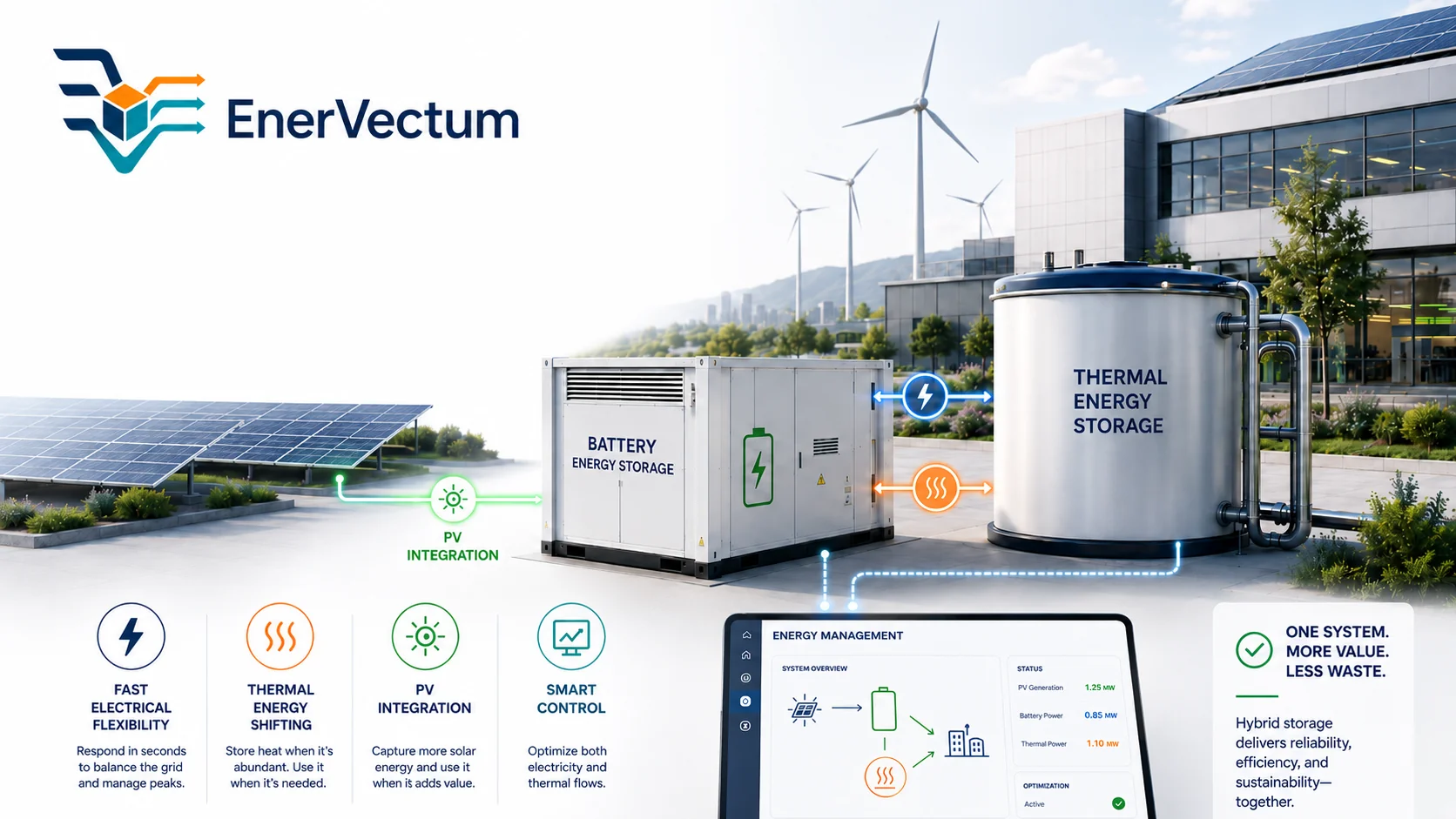
Many energy discussions start with a simple question: which storage technology is best? For real customer sites, that is usually the wrong question.
Buildings, light-industrial sites and local energy hubs do not only need one type of storage. They need the right combination of energy assets: batteries, thermal storage, PV, heat pumps, EV charging, grid electricity and coordinated operation. The value comes from how these assets work together.
The better question
Not “Which technology is best?” but “Which technology should solve which part of the site’s energy problem?”
Batteries are strong for power flexibility
Battery energy storage systems are highly valuable for fast electrical response. They can charge and discharge electricity quickly, support short-term peak management and help balance power flows.
For sites with EV charging, solar PV, variable electricity prices or grid-capacity limits, batteries can be an important part of the energy strategy. They are especially useful when the problem is electrical power, short response time or short-duration balancing.
But batteries are not always the lowest-cost or most suitable way to handle every energy need. When the final demand is heat, it may be more logical to store energy as useful thermal energy.
Thermal storage is strong for energy capacity
Thermal energy storage stores energy as heat or cold. This makes it especially relevant for buildings and industrial sites where a large part of the useful energy demand is thermal: space heating, hot water, process heat or cooling.
Instead of using electricity immediately when heat is needed, a site can produce and store useful heat when electricity is cheaper, cleaner or locally available. That stored heat can then be used later, reducing pressure on the electrical system during expensive or constrained periods.
This is where thermal storage becomes powerful. It creates energy capacity on the heat side of the site.
BESS
Best for fast electrical flexibility, power peaks, short-duration balancing and grid-related services.
TES
Best for useful heat, thermal energy capacity, heat shifting and longer-duration site-level flexibility.
Coordination
Supports better timing and coordination of assets based on price, demand, grid constraints and site priorities.
The value is in the combination
The strongest site-level solution often combines batteries and thermal storage. The battery can handle fast electrical needs. The thermal storage can handle useful heat and larger energy shifting. The coordination layer decides when each asset should operate.
This is especially relevant for sites with PV production. Solar electricity can be used directly, stored in a battery, converted into heat, stored thermally or used to support EV charging. Without coordination, these assets may compete. With coordinated operation, they can support each other.
Electrical layer
BESS, PV, EV charging, grid electricity and power tariffs.
EnerVectum coordination layer
Site data, thermal storage, coordination logic, forecasting and operational planning.
Thermal layer
Heating, hot water, heat pumps, useful heat, thermal storage and demand shifting.
Example: a PV-rich building
Consider a commercial building with rooftop PV, heating demand, planned EV charging and a grid connection that may become constrained during peak hours.
If the site only exports solar electricity when local demand is low, part of the value may be lost. If EV charging increases peak demand, grid costs may rise. If heating demand occurs when electricity is expensive, the building may face higher operating costs.
A hybrid storage strategy can change this:
- PV electricity can be used directly when demand exists.
- The battery can support short electrical peaks and EV charging.
- Thermal storage can absorb surplus electricity as useful heat.
- Heat pumps can operate at better times.
- The coordination layer can coordinate the system based on tariffs, weather, demand and site priorities.
The result is not only storage. It is a more flexible site energy system.
Why this matters for property owners
Property owners increasingly face a more complex energy landscape. Electricity costs, power tariffs, PV self-consumption, EV charging, heating electrification and grid capacity can no longer be treated as separate questions.
A battery may solve part of the power problem. A heat pump may solve part of the heating problem. PV may reduce part of the electricity bill. But if these assets are not coordinated, the site may still miss the larger value.
Thermal storage helps connect these issues because heat demand is often large, predictable and flexible over time. When combined with BESS and coordinated operation, it can become a practical tool for reducing peaks, using more local energy and improving resilience.
Why this matters for investors and partners
Investors and strategic partners are looking for scalable energy infrastructure, not only single pieces of hardware. A hybrid storage platform can create multiple value streams from the same site.
Potential value layers
- Lower energy cost through better timing of energy use
- Reduced peak-power exposure
- Higher local use of PV electricity
- More resilient building or site operation
- Better integration of EV charging
- Future readiness for flexibility markets and energy-service models
- Replication potential across portfolios and similar customer sites
This is why system-level integration matters. The business case is not only in one component. It is in how the energy stack works together at the customer site.
What makes EnerVectum’s approach different?
EnerVectum is built around a thermal-centred flexibility logic. The platform does not position thermal storage against batteries. Instead, it combines thermal storage with BESS, PV, heat pumps, EV charging, grid electricity and coordinated operation.
The distinctive role is the system-level approach: using thermal storage as a heat-side flexibility layer while coordinating mature electrical assets, site data and practical operational planning into a customer-site solution.
EnerVectum’s position
Batteries solve fast electrical flexibility. Thermal storage solves useful heat and thermal energy capacity. EnerVectum connects both into one site-level flexibility platform.
What should be measured in a pilot?
A serious pilot should not only show that equipment can be installed. It should show whether the combination creates measurable value.
Important pilot metrics include:
- How much PV electricity can be used locally instead of exported
- How much heat demand can be shifted
- How peak-power exposure changes
- How BESS and TES interact under real operating conditions
- How coordinated operation supports better charging and discharging behaviour
- How the concept can be repeated at similar sites
These measurements create the bridge from technical concept to commercial proof.
Conclusion
Batteries and thermal storage are not rivals. They are complementary flexibility tools. Batteries are strong for fast electrical power. Thermal storage is strong for useful heat and energy capacity. Intelligent control creates value by coordinating both.
This combination is especially relevant for buildings, light industry and local energy hubs where PV, heating demand, EV charging, peak costs and grid constraints overlap.
EnerVectum’s role is to organise these assets into practical, measurable and scalable site-level flexibility solutions.
Interested in hybrid storage for your site?
EnerVectum welcomes dialogue with property owners, customer sites, technology partners, investors and innovation actors interested in combining BESS, thermal storage and coordinated operation.